Nematodes against
BIOLOGICAL CONTROL OF COCKCHAFERS
Melolontha melolontha
The cockchafer belongs to the scarab beetle family (Scarabaeidae). The most widespread species in Central Europe is the common cockchafer (Melolontha melolontha). The cockchafer grows to a size of up to 3 cm. Its legs, antennae and wing covers are reddish brown, and the sides of its abdomen are characterised by white triangular markings. The fans at the end of its antennae are also typical. Cockchafers fly in the evening when the dandelions are in bloom.
HOW TO IDENTIFY COCKCHAFER GRUBS
Cockchafer grubs have a whitish, caterpillar-like body and three pairs of legs, which they use for digging. They have a light brown head capsule and can reach a length of 5-7 cm. This makes them considerably larger than grubs of other beetle species such as garden leaf beetles, June beetles or tumble beetles. Another characteristic feature of cockchafer grubs is that they move sideways.

LIFE CYCLE OF THE COCKCHAFER
A female cockchafer lays up to 70 eggs in various places, preferably in warm, sunny soil – often in places where she herself hatched. After four weeks, the eggs hatch into grubs, which remain in the soil for a total of three years. In July of the third year, the grubs pupate and hibernate in the soil as beetles. When the dandelions bloom the following year, the cockchafers leave the soil and, after flying, lay their eggs again. Cockchafers appear en masse in certain cycles depending on the region, with the notorious ‘cockchafer years’ occurring every 3-5 years. Adult cockchafers cause damage to trees by eating their leaves. When the beetles appear en masse, tree crowns are stripped bare.
DAMAGE CAUSED BY COCKCHAFER GRUBS
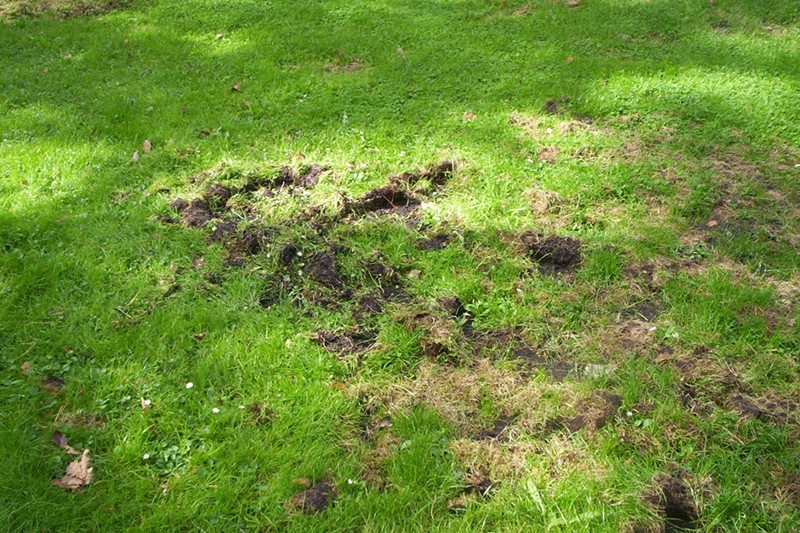
Cockchafer grubs cause the most damage in their second year, during the second larval stage. During this phase of their life cycle, grubs eat the most and cause plants to die within a single growing season. Just 1-2 grubs per plant are enough to cause this. Lawns, vegetables, strawberries and blueberries, perennials, shrubs and trees are all affected. Birds that peck at the grubs can cause immense damage to lawns with weak roots.
CONTROLLING COCKCHAFER GRUBS WITH NEMATODES
Nematodes are tiny, thread-like soil organisms measuring approx. 0.6 mm in length. They are natural enemies of cockchafers. The nematode genera Heterorhabditis and Steinernema specialise in cockchafer grubs, among other things, and can use them for their own nutrition and reproduction. The nematodes are delivered alive in a powder form. To apply them, they should be mixed with water exactly as instructed on the packaging and applied to the affected areas.

WHICH STAGES OF THE COCKCHAFER CAN BE CONTROLLED?
Control is generally difficult. Cockchafer grubs are most sensitive in the first larval stage. The smaller the grubs, the better the effect. Under favourable conditions, up to 50% of the grubs can be killed.
Application period: April/May to August/September
Recommended dosage: 0.75 million nematodes per m2
Two treatments should be carried out during this period: the first in April/May, when the grubs emerge from hibernation and are still weak, and a second in August/September against newly hatched grubs in the L1 stage. The treatment should be carried out for two years in a row.
Private users can order nema-green® Cockchafer directly from our online shop. Professional users can purchase our nematodes from our distribution partners.
Please contact us for further information.
Contact